

Canada’s new Immigration Levels Plan (2026–2028) was released this week as part of the Budget 2025, with important changes and updates. IRCC also published its 2025 Annual Report to Parliament on Immigration.
This is an important moment for our country and for newcomers. In this first update, we highlight key points. We will follow up soon with a full response and reaction.
The government presents this latest immigration plan as “taking a new approach to immigration”. IRCC has stated that:
“Canada’s new Immigration Levels Plan focuses on economic needs by bringing in workers for key sectors like health care and construction and attracting top talent for emerging industries.
The plan reduces temporary resident levels, stabilizes permanent resident targets, and strengthens Francophone immigration outside Quebec to ensure the system works better for newcomers and Canadians alike.
It also maintains Canada’s longstanding commitments to reunite families and support vulnerable populations, while keeping immigration aligned with economic and infrastructure realities.”
Highlights
Permanent Resident (PR) targets
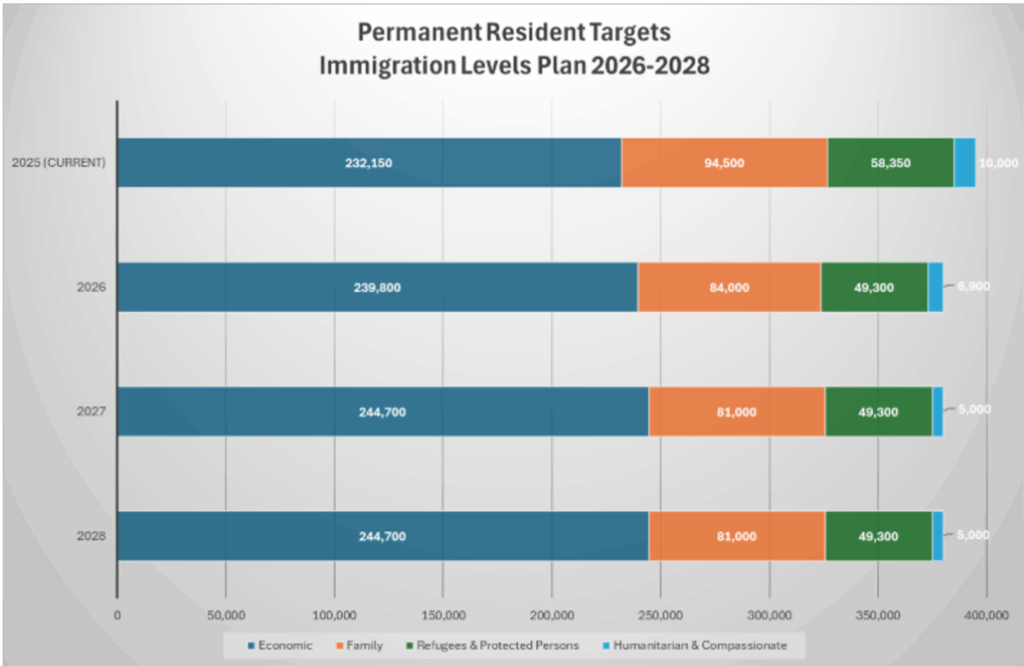
To continue to meet the goal of annual permanent resident admissions (less than 1% of Canada’s total population), the government will reduce permanent resident admissions to 380,000 per year from 2026 to 2028. This is a 4% reduction from the 395,000 target set for 2025.
Economic:
The economic category of admissions accounts for the largest share of admissions each year, reaching 64% in 2027 and 2028, up from 59% in 2025. A greater share of economic admissions will be allocated under ‘Federal Economic Priorities’ to skilled workers with a focus on critical sectors, such as health care and skilled trades.
An ‘International Talent Attraction Strategy’ will be launched to recruit top-tier international researchers to Canadian universities, strengthening Canada’s research ecosystem.
Additionally, greater emphasis will be placed on facilitating the transition to permanent residence for those who are already in Canada as students and workers, under an “in-Canada focus”.
Family:
Family arrivals will reduce by 11% from 94,500 in 2025 to 84,000 in 2026.
Refugee and Humanitarian:
Privately sponsored refugees (PSRs) will reduce by 30%, from 23,000 in 2025 to 16,000 in 2026. Government-Assisted Refugees (GARs) will reduce from 15,250 to 13,250. Total refugee and protected person arrivals will drop 15% from 58,350 in 2025 to 49,300.
Humanitarian, compassionate, and other arrivals will drop by 31% from 10,000 to 6,900.
The target for Francophone admissions destined for outside Quebec is increasing, reaching 10.5% by 2028, and 12% by 2029.
One-time special initiatives were announced to provide permanent residence to 115,000 Protected Persons (refugees accepted in Canada) over the next two years, and to fast-track permanent residence for 33,000 skilled temporary workers who are already contributing to communities and working in Canada in specific in-demand sectors.
Temporary Resident targets
To meet the goal of temporary residents making up less than 5% of Canada’s population, temporary worker arrivals will be reduced to 230,000 in 2026, a reduction of 37%.
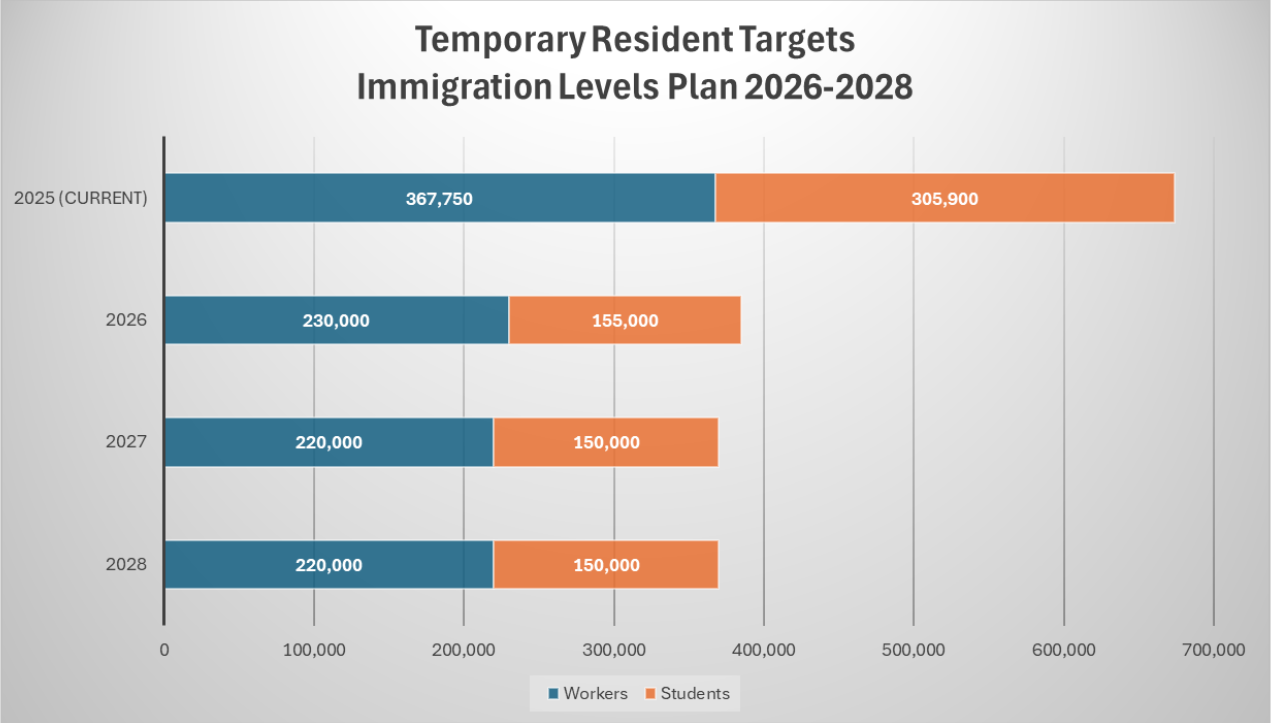
New student permits will be reduced 49% to 155,000 in 2026 (though IRCC figures show that in the first eight months of 2025 only 89,000 new international students arrived in Canada).
In developing this Levels Plan, the government consulted the public on immigration. Read the results here: Final Report.
Immigration spending
The government has set Immigration, Refugees and Citizenship Canada (IRCC) the goal of spending 15% less — about $619 million — over the next three years. This plan is not final yet, because the proposed federal budget still needs to secure a majority support in the House of Commons.
To reduce spending, IRCC plans to:
- Modernize how it works to make operations faster and cheaper.
- Spend less on asylum support as fewer people are expected to need it.
- Change the National Settlement program so that some economic immigrants may no longer be eligible for certain services.
- Introduce a small co-payment system for some health services under the Interim Federal Health Program — for example, prescription drugs and dental care.
In addition, Employment and Social Development Canada (ESDC) will receive funding to work with provinces and territories to make it easier, faster, and fairer for newcomers to have their foreign qualifications recognized, especially in the health and construction sectors.
Do you have questions about the new Levels Plan? Please email communications@issbc.org or our social media (LinkedIn, Facebook and Instagram) and we will try to answer.
Figures as announced subject to legislative approval/subject to confirmation by IRCC.